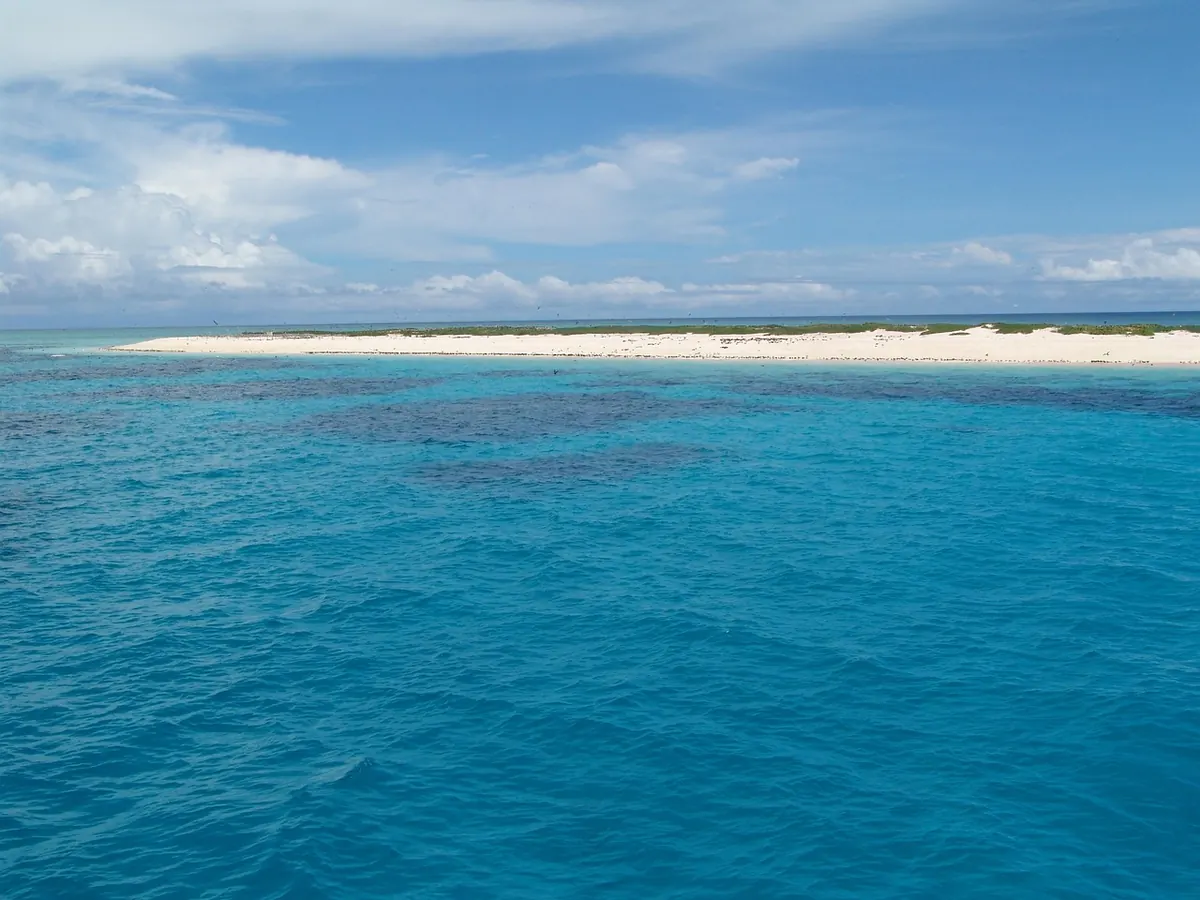
From a boat, a coral reef is hard to read. You see a band of paler water, a line of breaking waves, a sudden shift from turquoise to deep navy. Underneath, that same reef is a stack of different habitats, each shaped by light, wave energy and depth. Learn the main reef types and zones and you will pick better snorkel spots — and understand why the fish life changes so much over a few hundred metres.
Three reef types, built by the same slow process
Fringing reefs, barrier reefs and atolls are usually taught as a list, but they are really stages of one story. Reef-building corals need shallow, clear, warm water with plenty of light. When the land behind a reef subsides, or sea level rises, the coral keeps growing upwards and outwards, staying close to the surface while the water around it deepens.
A fringing reef hugs the shore. Widen the gap between reef and coast and you have a barrier reef, with a lagoon in between. Let the last of the land drop below the surface and you are left with an atoll: a ring of reef around open water. Charles Darwin set out this idea in the nineteenth century, and the broad outline still holds.
Fringing reefs: the ones you can wade to
Fringing reefs are the most common type and the easiest to snorkel. The reef begins at or near the shoreline, then slopes away to a shallow terrace before steepening at its outer edge. On a good fringing reef you can walk in from the beach and be over coral within a couple of minutes.
Two things are worth knowing. Reefs close to river mouths, harbours or built-up coastlines tend to carry more silt and nutrients, which often leaves them greener and less coral-rich than reefs further out. And the inner reef flat can be ankle-deep at low tide, so a high-tide window gives you more clear water over the coral and an easier swim. The best coral is usually at the outer edge, where cleaner water and gentle current bring food.
Barrier reefs: a lagoon's worth of distance
A barrier reef runs roughly parallel to the coast but sits one to several kilometres offshore, separated from the land by a deep lagoon. It is usually broken into sections by passes and channels, where tidal water flows in and out.
Snorkelling a barrier reef almost always means a boat trip. The reward is scale: long stretches of fore-reef coral, and passes where fish gather to feed in the current. On the lagoon side you will find calm, shallow patch reefs; on the ocean side, a slope that steepens into a drop-off. Ask a local operator which side is sheltered from the wind, and time your visit around slack water if you plan to snorkel a pass.
Atolls: rings left behind by sinking islands
An atoll is a ring of reef with a lagoon in the middle and little or no land — just a few low islands on parts of the rim. The ring is usually higher and better developed on the windward side, where waves push water steadily across the reef, and lower and more broken on the leeward side.
For snorkellers, an atoll offers a neat split. Inside, the lagoon is shallow, warm and calm: sand patches, coral heads, juvenile fish, the occasional ray cruising past. Outside, the reef drops away quickly into deep water, with bigger fish and better visibility. At the corners of the ring, passes empty and fill with the tide, and that moving water attracts the most life of all.
Reef zones, from the shore out
Whatever the reef type, zoning follows the same logic: how much light and how much wave energy reaches each part. Walking out from a beach on a fringing reef, you would cross most of these in one swim.
- Lagoon and back reef — sand, rubble and seagrass patches in roughly 0–3 m of water. Sheltered, good for beginners, and full of small fish, sea cucumbers and grazing turtles.
- Reef flat — the shallow pavement behind the crest, sometimes exposed at low tide. Warm, bright and often covered in brown algae and scattered coral heads rather than dense coral.
- Reef crest — the raised rim where waves break first. Often an algal ridge rather than a coral wall, and the most energetic part of the reef. Beautiful in calm weather, unpleasant and unsafe in a swell.
- Fore reef slope — the reef face below the crest, where coral cover is usually highest. Spurs of coral run seaward with sandy channels between them, carrying sand and water back off the reef. This is the classic snorkel territory, roughly 2–15 m down.
- Drop-off or wall — where the slope steepens into deep water. Light fades, hard corals give way to sponges and sea fans, and the fish tend to be larger and more mobile.
- Passes and channels — gaps in the reef where the tide runs hard. The strongest currents, the clearest water and the busiest fish life; also the zone that demands the most care.
Turning the zones into a plan
The practical skill is matching the zone to the day, the tide and the people you are with.
- Check the tide first. High tide usually gives more water over the reef flat and easier swimming; low tide exposes coral heads and can concentrate fish in the remaining pools.
- Start in the lagoon or back reef if you are new to snorkelling, with children, or if the sea is choppy. Calm, shallow and forgiving.
- Snorkel the fore reef slope on a settled day, and stay on the sheltered side of the reef if the wind has been blowing.
- Treat the crest with respect. If waves are breaking over it, do not swim across it. Watch how the water moves for a few minutes before you commit.
- Time passes for slack water and go with a guide or boat cover. Drift snorkelling a pass is superb when the current is mild and genuinely risky when it is not.
- Ask locally. Someone who swims the same reef every week knows which side is clear and which is silty after rain.
Wherever you end up, keep fins off the coral, give yourself room from the bottom, and never snorkel alone in an unfamiliar area. If you have a heart, lung or ear condition, get advice from a doctor before you get in. A little planning means you spend your time watching the reef rather than fighting it — and you will notice far more of it.
Photo: steinchen / Pixabay