Ask a room of reef keepers which two numbers they check most often and you will hear the same pair twice: nitrate and phosphate. They get mentioned in the same breath so often that it is easy to assume they behave the same way. They do not. Nitrate is the end point of a chain of conversion; phosphate is an element that has to be physically removed. Understanding that one difference makes every decision afterwards — feeding, filtration, testing — much simpler.
Two elements, two very different problems
Nitrate is the last visible step in the nitrogen cycle. Food goes in, fish produce ammonia, bacteria in your live rock and filter media convert that to nitrite and then to nitrate. All of those steps happen in oxygen-rich water. Converting nitrate into harmless nitrogen gas, however, needs the opposite: slow, low-oxygen zones inside porous rock, deep sand or a dedicated reactor. That is why nitrate tends to creep up in a busy tank with good flow and nowhere for anaerobic bacteria to work.
Phosphate does not follow a chain at all. It arrives as food, fish waste, decaying livestock, impurities in additives and sometimes in your source water or salt mix. Nothing converts it into something easier to remove. It either gets taken up by algae, bacteria and corals, or it binds to rock and substrate, from which it can leach back later. That stored phosphate is the reason a tank can test clean for weeks and then show a reading again after a heavy feeding session.
Food contains both nutrients, and the ratio in a typical diet is not the ratio your tank consumes them in. Many keepers aim for nitrate somewhere between 2 and 10 ppm, with phosphate around 0.03 to 0.1 ppm, but the useful number is the one your tank settles at with healthy coral colour, steady growth and no nuisance algae.
Testing: what each kit can and cannot tell you
Nitrate kits
Most hobby kits use either cadmium reduction or a reagent that colours in proportion to nitrate. Some of them cannot tell nitrate apart from nitrite, so a nitrite spike after a big feed or a bacterial bloom can read as a false high nitrate result. Before you act on a sudden jump, retest the following day with a clean sample. Match colours in daylight or a white LED, not under a warm room light, and replace reagents once they are past their date — an old kit is worse than no kit, because it gives you confidence you have not earned.
Phosphate kits
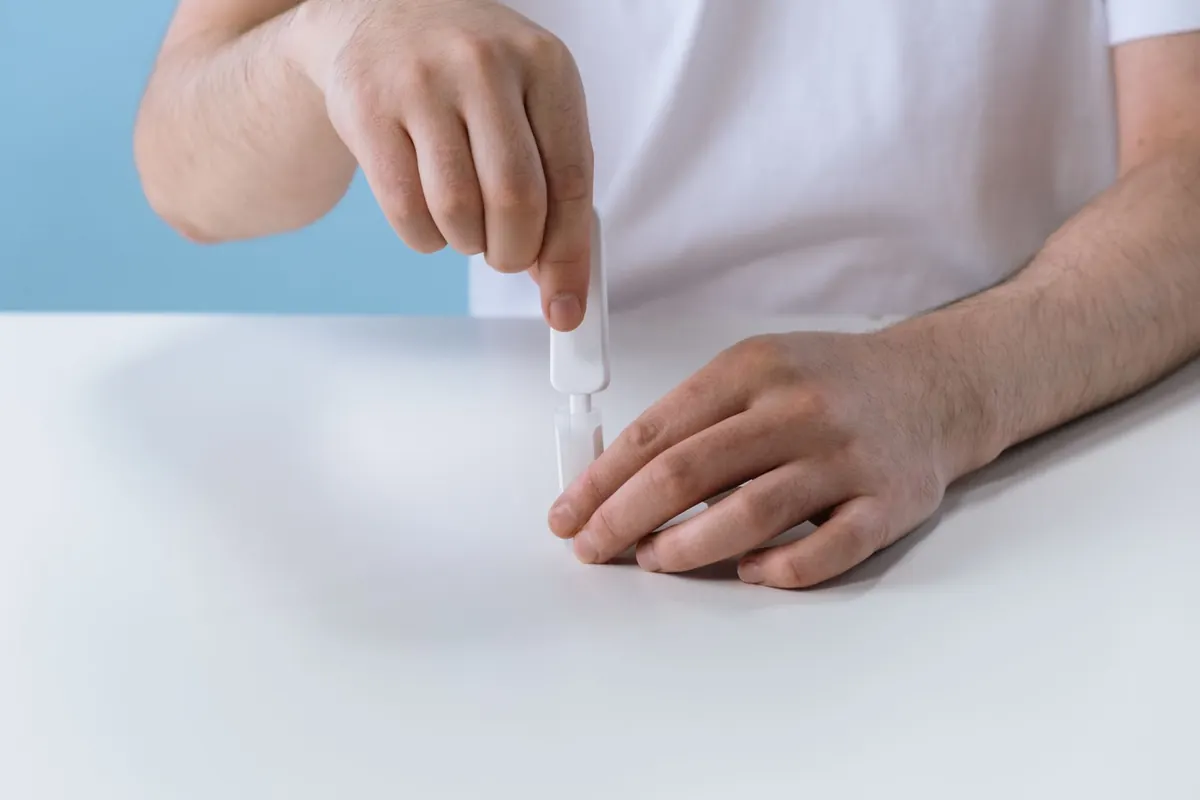
Phosphate is harder. It is the nutrient we care about at very low levels, and low levels are exactly where colour-matching kits struggle. A reading of "0.03" from a comparison card is often neither accurate nor repeatable. A handheld colorimeter gives you a real number rather than a shade, and some report phosphorus in parts per billion, which you multiply by roughly three to get phosphate. If you are chasing a stubborn algae problem, a laboratory water test is worth the postage: it measures both nutrients precisely and picks up things your home kit cannot.
Algae and bacteria eat phosphate before your test kit ever sees it. A low reading in a tank full of hair algae is not proof that phosphate is under control.
Whatever you use, test the same way each time: same hour, before feeding, same lighting. Trends tell you more than single readings.
Bringing nitrate down
Nitrate responds to export and to anaerobic processing. The practical options, roughly in order of how quickly most people see a change:
- Reduce input. Feed slightly less, more often, and rinse frozen food before it goes in. Uneaten food is the single most common source.
- Skim wetter. A skimmer removes organic waste before it ever becomes nitrate.
- Grow something. A refugium full of Chaetomorpha or other macroalgae consumes nitrate and phosphate as it grows, and you harvest the growth by hand. It is the closest thing to a two-for-one in this hobby.
- Carbon dose. Vodka, vinegar or biopellets feed bacteria that consume nitrate and phosphate, but they need a strong skimmer and careful, gradual dosing. Overdo it and you will strip oxygen from the water.
- Add anaerobic volume. Porous media, a sulphur denitrator or a mature deep sand bed gives bacteria somewhere to finish the job.
- Water changes. Useful, but do the maths. A 20 per cent change with zero-nitrate water drops nitrate by 20 per cent at best. At 40 ppm that means going from 40 to 32 — helpful maintenance, slow correction.
Bringing phosphate down
Phosphate has to be bound or exported. Water changes help far less than most people expect, because the problem is often in the rock as much as the water. The reliable tools are:
- Granular ferric oxide in a reactor or media bag. Effective, cheap to run, and it needs replacing before it exhausts.
- Aluminium-based removers, which work well but should be introduced gently.
- Lanthanum chloride, dosed into a filter sock or skimmer intake. Powerful, and easy to overdo — go slowly and watch your alkalinity.
- Refugium growth and carbon dosing, which handle both nutrients at once.
- Less food, better filtration. The same boring answer as nitrate, and usually the most effective.
When the two drift apart
Tanks rarely run out of both at once. Nitrate climbing while phosphate stays low often points to insufficient anaerobic capacity rather than overfeeding. Phosphate climbing while nitrate drops usually means a refugium or carbon dose is working on the nitrogen faster than the phosphorus, or that bound phosphate is leaching from rock. Treat the one that is out of range, change one thing at a time, and give it two or three weeks before judging the result.
A simple routine that works
Test nitrate and phosphate on the same day each week, before feeding, and write the numbers down — a notebook or a spreadsheet beats memory every time. Feed a consistent amount and rinse frozen food. Empty and clean your skimmer cup regularly, because a neglected skimmer stops exporting anything. Harvest your refugium when it fills the space, not when you remember. If a number is out of range, pick one reduction method and apply it gradually rather than stacking three at once; you cannot tell what worked otherwise, and you risk stressing corals unnecessarily.
Keep those habits steady and both nutrients become what they should be: two ordinary parameters you check, adjust and forget about, rather than a running battle.
Photo: cottonbro studio / Pexels