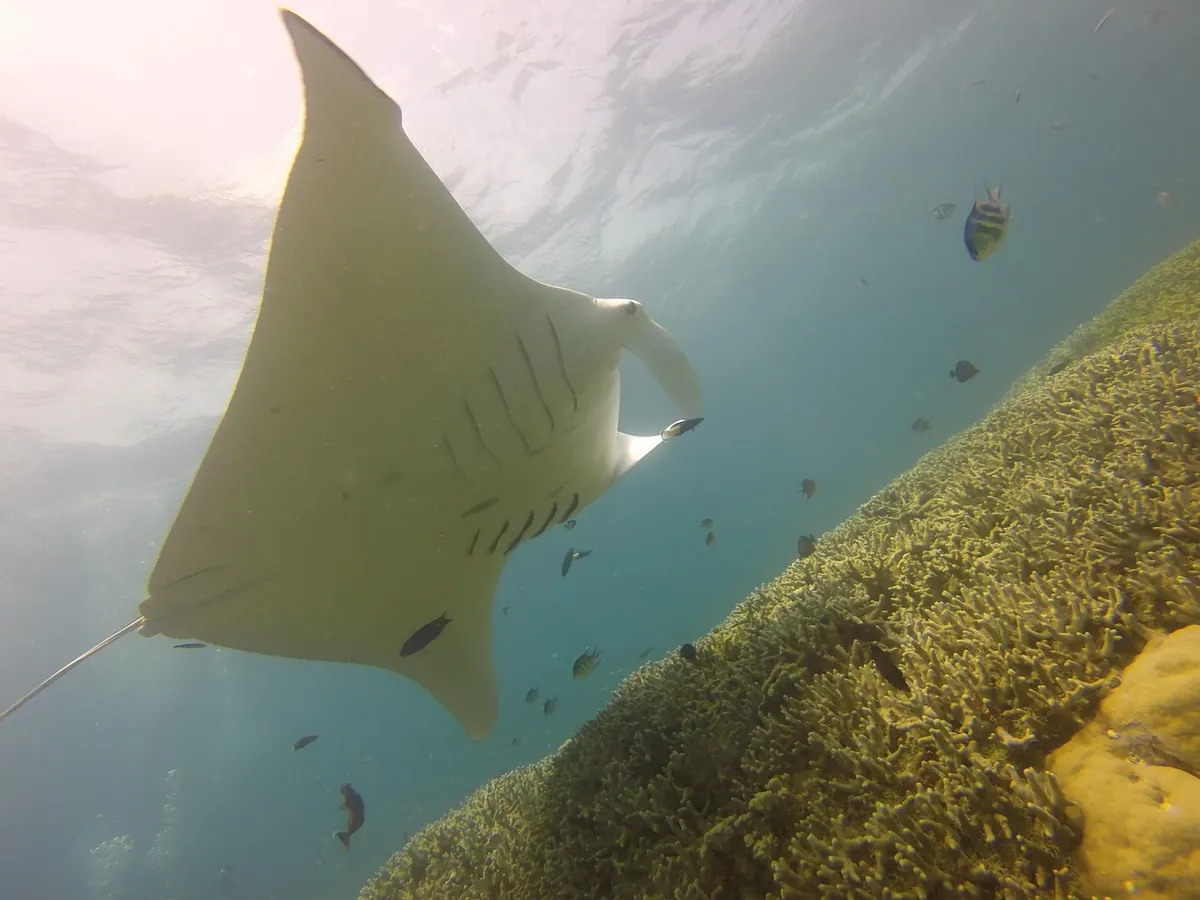
You can see reef mantas in the Maldives in any month of the year. What changes is where they gather, why they are there, and how they behave when you slip into the water beside them. Time it right and you might watch a dozen animals barrel-rolling through a plankton cloud in Baa Atoll, or spend an entire dive hovering over a cleaning station while a single manta hangs almost motionless, letting a tiny wrasse work along its gills.
Time it wrong and you will spend a fortnight staring at beautiful, empty blue. The difference usually comes down to the monsoon, the tide and your own behaviour in the water.
Two Monsoons, Two Kinds of Manta Diving
The Maldives runs on two monsoons, and each one produces a very different encounter with Mobula alfredi, the reef manta.
The southwest monsoon, roughly May to November, brings wind, rain and nutrient-rich water welling up from the deep. Plankton blooms, and mantas follow the food. This is the season for feeding aggregations, for whale sharks, and for the bays and channels where large numbers of mantas can be present at once. Visibility is rarely at its best and currents can be brisk. If you want mantas in quantity rather than perfect blue water, this is your window.
The northeast monsoon, roughly December to April, brings calmer seas and clearer water. Plankton thins out, feeding aggregations break up, but mantas still need cleaning. They return to reef cleaning stations, often the same coral heads year after year, and there you can watch them at close range for long, unhurried periods. The classic sites sit in North Malé Atoll, Ari Atoll and around Rasdhoo.
Treat these as patterns rather than promises. Weather shifts, plankton is unpredictable, and a late or early monsoon can move everything by a few weeks. Ask your operator what has actually been seen in the past fortnight, not what the brochure says.
Hanifaru Bay and the Southwest Monsoon Peak
Hanifaru Bay, on the eastern edge of Baa Atoll, is the Maldives' most famous manta site and sits inside a UNESCO Biosphere Reserve. Between roughly June and October, plankton gets funnelled into the bay on the incoming tide and mantas gather to feed, often in spectacular fashion: chains of animals swimming nose to tail, then peeling off into slow barrel rolls through the densest soup.
The rules here are strict, and rightly so. Hanifaru Bay is a snorkelling site only, with no scuba diving permitted. The number of boats and the number of people in the water at any one time are capped, time in the water is limited, and rangers oversee the whole thing. You visit with a licensed operator, not on your own. Expect it to be busy in peak season, and accept that you are one of many people hoping for the same moment.
What a session actually looks like
You will usually get a thorough briefing on the boat, then enter the water as a tight group and drift with the flow rather than swimming against it. Guides position snorkellers to the side of the action, not through the middle of it. Your job is simple: stay low, stay quiet, keep your fins under control and let the mantas decide how close they come. They often come very close indeed.
The Northeast Monsoon: Cleaning Stations and Clear Water
From December to April, the action moves to the reefs. Mantas visit cleaning stations to have parasites removed by small reef fish, and at these sites they are remarkably tolerant of well-behaved divers. The payoff is time: a single manta may hold position for twenty minutes or more, circling slowly back to the same coral head between passes.
These dives are often current dives. You may need to tuck into the lee of a reef, hold a fin grip on bare rock where local practice allows, or simply hover low and let the current carry you past. Do not grab live coral to hold position, and never park yourself directly over the coral head the mantas are using.
Tides, Moons and Reading the Water
Mantas respond to water movement far more than they respond to the calendar. Two practical points are worth building your day around:
- Work the incoming tide. Plankton is pushed into bays and channels on the flood. Slack water at a feeding site can be genuinely empty, while the same spot two hours later is heaving.
- Ask about tidal range. Spring tides around the new and full moon move more water, which often means stronger flow and richer feeding conditions. Neap tides are gentler but can be quieter.
- Go early. The first boats in the water often get the clearest run at a site before the day's traffic builds.
None of this replaces a good guide. Local knowledge about which corner of a channel fires on which tide is worth more than any general rule.
Underwater Etiquette That Mantas Notice
Mantas are curious but they are not tame. A manta that veers away, drops its fins or accelerates is telling you something. Keep these habits:
- Stay low and stay still. Let the animal close the distance, and never swim directly at it.
- Keep your distance: around three metres as a minimum, and more at cleaning stations where the mantas have come to rest.
- Never touch a manta, never ride the pressure wave above one, and never block its path to the surface or to its cleaner fish.
- Do not split a line of feeding mantas or cut between a manta and the reef.
- Skip the flash entirely. Sudden light at a cleaning station can send an animal away for the rest of the dive.
- Control your fins and your bubbles. A tight, quiet group of divers gets far closer than a sprawl of flailing legs.
- If you are snorkelling, stay flat on the surface and resist the urge to duck-dive at an animal.
Responsible Photography
You do not need a housing the size of a suitcase to come home with a good manta image. You need patience and position.
- Shoot on natural light, with no strobe or flash near the animals.
- Use a wide lens, get low, and wait for the manta to turn across open blue rather than against a blown-out sky.
- Set a shutter speed fast enough to freeze the wings — around 1/160 to 1/250 — and keep your ISO low if the light allows.
- Anticipate. Move into position ahead of the animal, then hold still and let it come to you.
- For video, take short, steady clips. No frantic panning, no chasing.
- Photograph the belly. The unique spot pattern underneath each manta is used to identify individuals, and submitting clear underside shots to a recognised manta ID project genuinely helps research.
- Put the camera down for part of the dive. The best encounters are the ones you actually watch.
Planning Your Trip: Practical Notes
Book with operators who brief mantas properly and cap group sizes; if a dive centre cannot tell you its manta code of conduct, that is your answer. Liveaboards give you the flexibility to chase conditions, while island-based trips suit the Maldives' calmer northeast season.
Be honest about your experience. Manta dives are often drift dives with current, so decent buoyancy control and comfort in moving water matter more than a long dive log. Bring a rash vest for snorkelling sessions, keep sunscreen use to a minimum, and drink more water than you think you need.
If you have any doubt about your fitness or medical history for diving, speak to a diving doctor before you travel, and check that your insurance covers the diving and snorkelling you are planning. Then go quietly, go slowly, and let the mantas set the pace.
Photo: arhnue / Pixabay